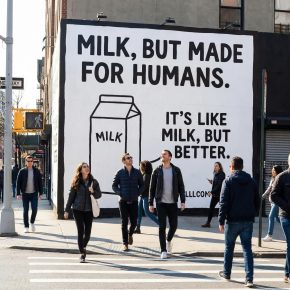
Greg Hahn said it best: “Your brand doesn’t have the budget to be boring.”
He wasn’t just talking about creative risk—he was issuing a survival warning.
For years, marketers have optimized for efficiency over distinction. Media dashboards glowed green, ROAS curves looked healthy, and performance channels delivered what seemed like growth. But something broke.
Scroll fatigue. Declining engagement. The plateau of sameness.
“Good enough” is brand death. Because when every feed, storefront, and stream looks the same, the only thing that cuts through isn’t spend—it’s soul.
The Performance Hangover
AdAge recently reported that nearly 70 percent of CMOs are shifting dollars from pure performance into brand building after watching short-term gains evaporate as quickly as they appeared.
Performance marketing trained an entire generation of brands to chase conversion before connection. It rewarded optimization over originality. But as The Drum’s Future of Marketing 2025 series revealed, that efficiency has reached diminishing returns. When algorithms flatten everything, differentiation becomes your only defensible edge.
The problem isn’t that performance channels failed; it’s that brands forgot who they were talking to.
Clicks aren’t customers. Impressions aren’t influence. And while automation can buy attention, only brand creates affection.
Agency Squid calls this the “attention gap.” It’s the chasm between getting seen and getting chosen—a gap that only story, design, and cultural relevance can close.
The End of “One Big Campaign”
The days of the single tentpole campaign—the year-long, multi-million-dollar anthem—are fading fast. Campaign magazine’s 2025 “Creativity Forecast” put it bluntly: “Culture doesn’t wait for your production schedule.”
Audiences live in real-time loops. They discover on TikTok, validate on Reddit, buy through DTC drops, and show loyalty through Discord. Each channel carries its own rhythm, humor, and vernacular. A single hero film can’t flex across them.
What today’s brands need isn’t a campaign—it’s an ecosystem: modular ideas that adapt natively to every channel without losing coherence.
AdWeek describes this shift as “channel specificity”—building creative that speaks the language of each platform instead of forcing one idea everywhere.
For brand managers, this means re-engineering the creative process: smaller bets, faster learnings, continual cultural calibration. Agency Squid’s hybrid model was designed for that—embedding strategy and creative ops inside client teams so brands can move at the speed of culture, not procurement.
Boring Can’t Be Optimized
Greg Hahn’s quote echoes because it’s brutally true: boring is the most expensive thing you can be.
When you’re forgettable, you’re forced to overpay for awareness. You spend more to say less.
AdAge analysis shows that distinctive creative delivers 5–11 times more profit than “average” advertising. The Drum found that creative quality outperforms media weight 4:1 in driving long-term growth.
Yet many brands still dilute bold ideas out of fear—of alienating, of risk, of boardroom second-guessing. The result? Campaigns engineered to offend no one and inspire no one.
Agency Squid’s mantra—creativity that rewrites the shelf story—exists precisely because markets reward courage. Every challenger that becomes a leader does so by standing for something unmistakable. White Claw didn’t invent seltzer; it invented attitude. Zesty Paws didn’t invent pet supplements; it invented personality.
Safe doesn’t scale.
From Channels to Contexts
Performance marketing thrived on channels; brand marketing thrives on contexts.
The smartest marketers are no longer asking “What’s our media mix?” but “Where does our audience emotionally live?”
Campaign calls this the context economy—where meaning is shaped not by placement but by presence.
For instance, when Summit Brewing activates “Beer for Here” around Minnesota cultural rituals, it’s not buying impressions—it’s buying belonging. When Silver Oak aligns with Paravel luggage to elevate luxury travel, it’s not a co-brand—it’s a cultural statement about craft and care.
Each is a moment-based strategy, not a media buy.
Performance teams that understand context find exponential results. Brand managers who cling to last year’s channel plan get left behind.
The Audience Knows the Difference
Modern audiences can spot automation quickly.
Brands that earn attention now behave more like people: imperfect, funny, curious, and opinionated.
As Wired noted in its Attention Economy 2.0 report, “Authenticity is now an algorithmic advantage.” Platforms reward engagement that feels human. The more manufactured the content, the faster it dies.
That’s why good-enough messaging—over-templated, under-inspired, strategy-free—doesn’t just fail quietly. It signals indifference.
And indifference, in culture, is fatal.
Building for Distinction, Not Distribution
The path forward isn’t more content—it’s better distinction.
Start with clarity of purpose. Why do you exist beyond the sale? Then, translate that purpose into creative systems built for velocity and variation.
Agency Squid uses a three-part framework—Cultural Relevance, Creative Impact, Commercial Success—to keep brand ecosystems both focused and flexible.
- Cultural Relevance: Grounded in social and behavioral insight. What are people doing, saying, and celebrating right now?
- Creative Impact: Build modular ideas that can stretch—from short-form video to retail experience—without losing emotional truth.
- Commercial Success: Track beyond clicks. Measure lift in share of conversation, organic mentions, and retail velocity.
When those three align, brands become fluent—not just frequent.
The Return of Brand
If 2020–2024 was the era of performance obsession, 2025 is the return of brand.
AdWeek’s CMO Next panel summed it up: “We optimized our way into invisibility.” The pendulum is swinging back to storytelling, identity, and creative craft—not as nostalgia, but as necessity.
This isn’t a rejection of performance marketing—it’s an evolution. The two must work in sequence: brand creates demand; performance captures it.
When brand storytelling primes emotion, performance efficiency multiplies it. Without brand, performance is math without meaning.
The Cost of Playing It Safe
“Good enough” brands believe category conventions protect them. In truth, conventions camouflage them.
According to Campaign’s BrandZ 2025 report, brands that invest consistently in distinct creative and brand experience outperform their peers by 31 percent in long-term value. Those that retreat into performance-only strategies shrink.
The reason is simple: culture punishes apathy.
Audiences reward bravery because it feels human. They rally around opinions, share risks that pay off, and ignore brands that only echo the category.
So when the next quarterly review asks for “one big idea,” the right answer might be a hundred small ones—each calibrated to a channel, a subculture, a moment worth joining.
From Optimization to Imagination
Automation can’t manufacture meaning. AI can draft headlines, but it can’t feel tension. Algorithms can predict behavior, but they can’t create desire.
Brand managers who recognize that distinction will own the next decade. Those who chase efficiency at the expense of distinction will fade into the feed.
Greg Hahn was right: your brand doesn’t have the budget to be boring.
Neither does your audience.